













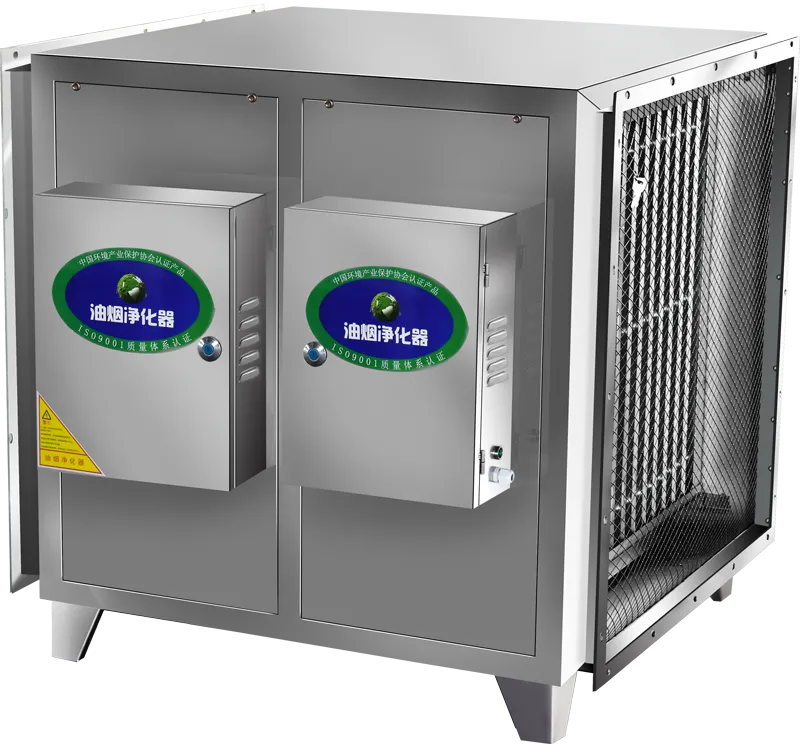
Technical Requirements and Test Specifications for Oil-Fume Purification Equipment in the Foodservice Industry
Publish Time : 2021-06-04 Author : Longde R&D
1-Scope
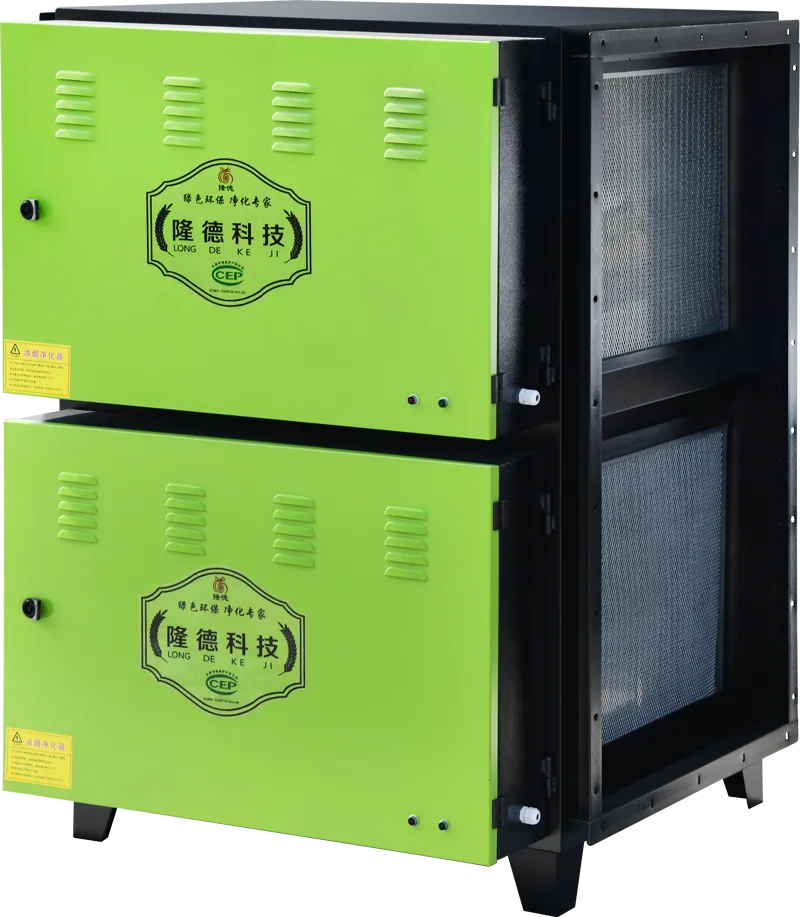
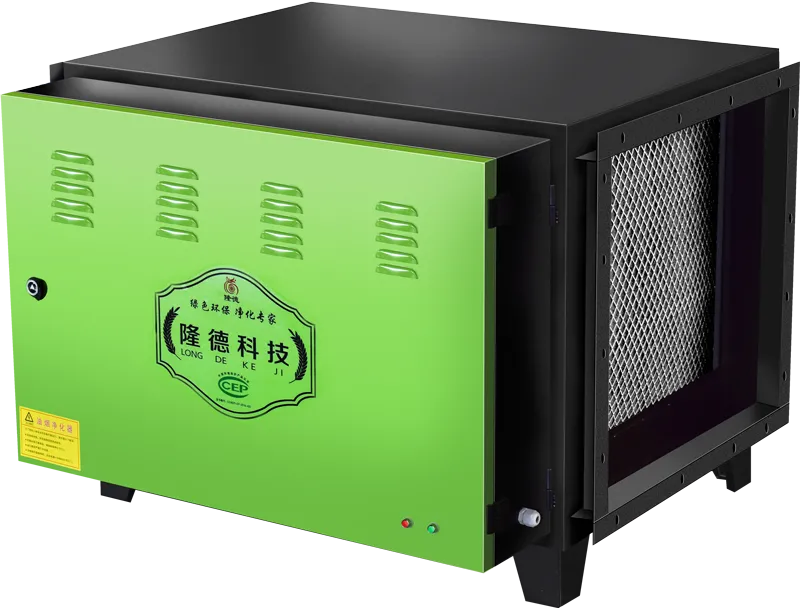
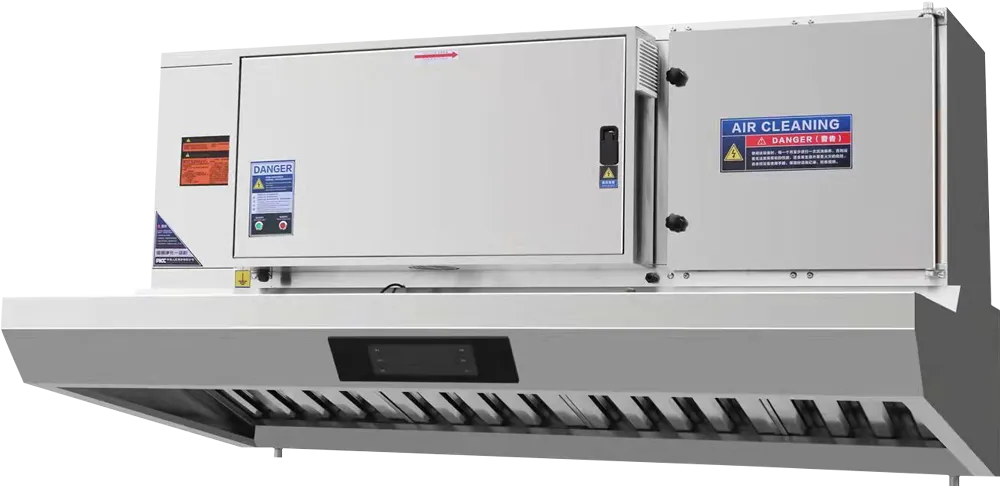
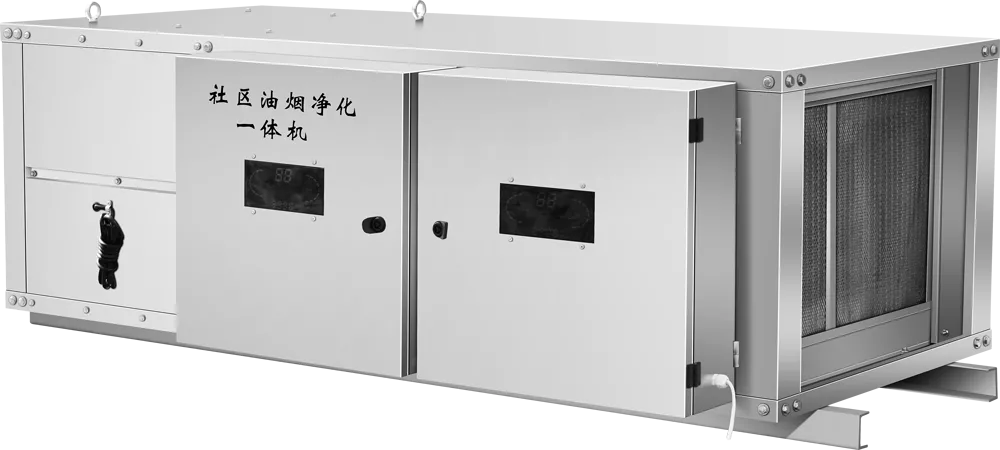
This standard specifies the technical requirements, testing techniques and inspection rules for the removal efficiency and other performance of cooking smoke purification equipment in the catering industry.
This standard is suitable for testing the removal efficiency and other performance of oil fume purification equipment generated during cooking and video production, and is suitable for oil fume purification equipment, whose processing air volume is 2000m ³/h ~ 20000m ³/h.
2-Specification reference
The provisions contained in the following standards constitute the provisions to which reference is made in this standard.
GWPB 5-200000 Emission Standard for the Food and Beverage Industry
GB/T 16157-Sampling methods for the determination of particulate and gaseous pollutants in exhaust gases from stationary sources
GB 191 GRAPHICAL MARKER FOR PACKAGING, STORAGE AND TRANSPORTATION
GB/T 6388 Markings for transport and receipt of transport packages
GB/T 9969.1-Description of Industrial Products
GB/T 13306 label
3-Terms and Definitions
The following terms and definitions apply to HJ/T 62
3.1-Standard Status
refers to the state at a temperature of 273K and a pressure of 101325 pa. The concentration values and air volumes specified in this standard are dry smoke values under standard conditions.
3.2-Cooking Smoke
refers to the mixture of volatile oil, organic matter, thermal oxidation and thermal cracking produced during food cooking and food production and processing.
3.3-Cooking Smoke Control Equipment
refers to equipment that decontaminates oil fumes produced during cooking and food production.
3.4-Flue Gas Removal Efficiency
It refers to the percentage of the quality of petroleum smoke processed by purification equipment in the catering industry, compared with the quality of petroleum smoke before treatment.
3.5-Mechanical flue gas purification equipment
refers to purification equipment that eliminates oil fume through filtration, inertial collision, adsorption or other mechanical principles.
3.6-Wet Smoke Purification Equipment
refers to purification equipment that uses liquid absorption principles such as water film, spray and impact to remove oil fume.
3.7-electrostatic flue gas purification equipment
refers to the use of electrostatic principle to remove oil fume purification equipment.
3.8-composite oil and gas purification equipment
4-TECHNICAL REQUIREMENTS
4.1-Basic Requirements
4.1.1-At the rated air volume, the body resistance of wet smoke purification equipment and electrostatic smoke purification equipment should be less than 300pa, and the body resistance of mechanical smoke purification equipment and composite smoke purification equipment should be less than 600pa.
4.1.2-Oily dirt and wastewater separated and collected shall not be discharged directly to cause secondary pollution. Solid waste (e. g. filter materials replaced by mechanical smoke purification equipment) should be treated centrally and will not cause secondary pollution.
4.1.3-Electrostatic flue gas purification equipment should have eye-catching safety warnings and reliable grounding to ensure personal and equipment safety.
4.1.4-The grounding resistance of the electric control box shall be less than 2Ω.
4.1.5-Have complete technical documentation, including design instructions, drawings, company standards, etc.
4.1.6-The appearance of the product should be smooth and clean to facilitate installation, maintenance and maintenance.
4.2-Technical requirements for testing
4.2.1-Under laboratory test conditions, under the condition of rated processing air volume, the oil fume removal efficiency of the oil fume purification equipment should meet the requirements of Table 1. For the removal efficiency test of equipment less than 1 year, the test value should be corrected according to Table 1 multiplied by the operating time correction factor K.
Minimum Removal Efficiency Limit of Oil Fume Purification Equipment
| Rated processing air volume, m³/h | ≥ 2000 -<6000 | ≥ 6000-<12000 | ≥ 12000 |
| Operating time correction factor K | 0.85 | 0.95 | 1.0 |
| Minimum deletion efficiency,% | 60 | 75 | 85 |
4.2.2-Under normal use conditions, the continuous operation time of the equipment should not be less than 1 year.
4.2.3-The removal efficiency of petroleum flue gas purification equipment that has been in operation for more than 1 year shall meet the minimum removal efficiency requirements in Table 1.
4.2.4-The insulation resistance between the two plates of the electrostatic flue gas purification equipment shall not be less than 50mΩ.
4.2.5-The performance of the wet smoke purification equipment is good, and the moisture content of the flue gas at the outlet of the exhaust pipe is less than 8%.
4.2.6-The petroleum flue gas purification system should be in good order, and the air leakage rate of the equipment itself should be less than 5%.
5-Detection system and test method
5.1.1-Ventilation connection system
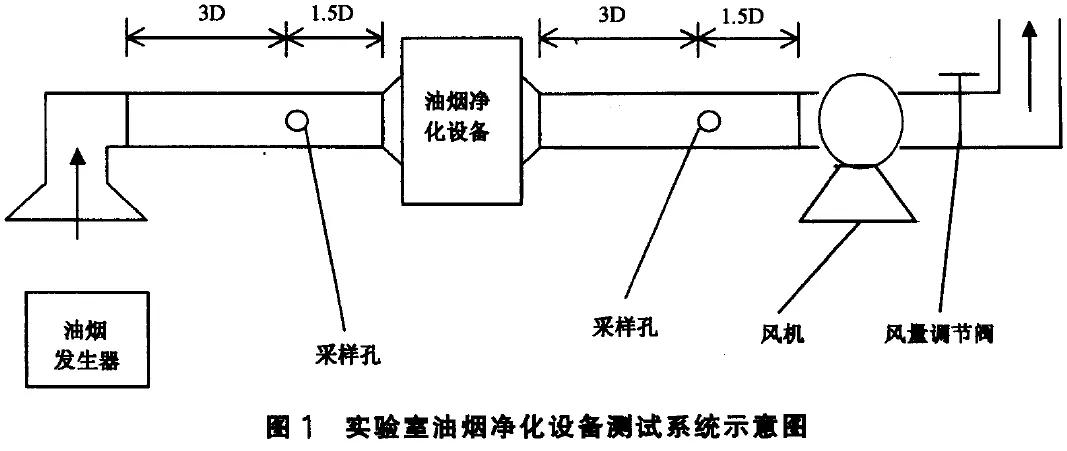
As shown in Figure 1, the ventilation pipe connection system includes oil fume purification equipment, fans, connecting pipes, sampling holes and air volume regulating valves. The inlet and outlet air connection pipes shall be 4.5 times the diameter (or equivalent diameter). The sampling hole is set to 3 times the downstream diameter (or equivalent diameter) of the elbow, reducer and other pipe fittings. For a rectangular pipe, the equivalent diameter d = 2ab/(a B), where a and B are the side lengths. The layout of sampling points shall be in accordance with Chapter 7 of GB/T 16157.
5.1.2-Flue Gas Generating Equipment
Thepetroleum fume generating device simulates the actual fume composition by adding edible vegetable oil and water quantitatively in heating and melting, so as to make it smoke, splash and evaporate, so as to continuously and stably produce fume. The equipment mainly includes two parts: an adjustable oil and water quantitative addition system and an electric heating temperature control system, as shown in Figure 2. The fume generator should ensure that the average fume concentration changes less than 5% within 10 minutes. The petroleum flue gas generating device can adjust the amount of oil fume generated to meet different gas processing capacity and concentration requirements. The detection reference concentration is 10mg/m³.

5.2 test method
5.2.1-Temperature measurements shall be made with an accuracy of not less than 2.5 percent by glass thermometers or thermocouples.
5.2.2-Using standard pitot tube or S-type pitot tube, inclined tube pressure gauge, U-type pressure gauge and atmospheric pressure gauge, the speed, flow rate and pressure should be carried out in accordance with Chapter 7 of GB/T 16157. Other calibrated measuring instruments with the same accuracy can also be used.
5.2.3-Insulation resistance: Use a 2.5 grade 2500V megohmmeter to measure the resistance between the two rods of the electric field body. Ground resistance: Use a class 2.5 multimeter to measure the resistance between the metal housing and the ground bolt.
5.2.4-Various equipment, tools and detection methods for oil fume sampling and analysis should be carried out in accordance with Appendix A of GWPB 5-2000.
5.2.5-The appearance of smoke decontamination equipment shall be checked by visual inspection.
5.2.6-The moisture content of the flue gas at the outlet of the wet flue gas purification equipment should be determined according to the provisions of Chapter 5 of GB/T 16157. It can also be determined using the dry protein table thermometer or the clotting tube method when using a heated sampling tube.
5.2.7 Calculation of removal efficiency of oil fume purification equipment
p =(1-(C×Q -C×Q) /(C×Q))×100%;
P: Purification and removal efficiency of petroleum flue gas (%);
C: Fume concentration before purification equipment (mg/m³);
Q: Flue gas flow rate before purification equipment (m³/h);
Concentration of oil fume in cafe afterpurification equipment (mg/m³);
Q: Flue air flow after purification equipment (m/h);
5.2.8-Determination of the removal efficiency of flue gas purification equipment under laboratory conditions
The oil fume purification equipment in the test system is operated for 24 hours with the rated air volume and the simulated oil fume concentration of 50 mg/m³, please adjust the smoke volume to the simulated oil fume concentration of 10 mg/m³(± 2 mg/m³), to measure the oil and gas concentration and air volume, and to be 5. equal according to the inlet and sales volume of the equipment. correction factor. The average of two parallel measurements is reported.
The air volume on thedetection system was changed to 80% and 120 of the rated air volume on the nameplate, and the simulated flue gas concentration was adjusted accordingly to measure the flue gas removal efficiency of the flue gas purification equipment.
The test items and results oflaboratory tests shall meet the requirements of Table 2.
5.2.9-Performance testing of equipment that has been in operation for more than 1 year
The manufacturer of petroleum fume purification equipment should provide a list of five or more users who have used it for more than one year, and the approved petroleum fume purification equipment testing agency should select two units for operation time investigation and use the fume generator Test. The test items and results shall meet the requirements of Table 2.
Requirements for test articles and fume purification equipment
| Serial Number | Inspection Items | Laboratory Test Items | In-Site Test Project | Plant-Exit Inspection Project | Technical requirements |
|---|---|---|---|---|---|
| 1 | Technical Documents | Yes. | No. | No. | Drawings, design specifications and corporate standards shall be completed |
| 2 | product Appearance | yes | yes | yes | it should be smooth and clean to facilitate installation, maintenance and repair. Electrostatic decontamination equipment shall have an obvious safety warning. |
| 3 | Nameplate | Yes. | Yes. | Yes. | Comply with GB/T 13306 |
| 4 | Instruction Manual | Yes. | No. | Yes. | Comply with GB/T 9969, and indicate equipment maintenance cycle and service life |
| 5 | Purifier body resistance | Yes. | Yes. | No. | Wet-Type and Electrostatic-Type ≤ 300pa; Mechanical-Type and Composite-Type ≤ 600pa |
| 6 | Control box grounding resistance | Yes. | Yes. | Yes. | <2 Ω |
| 7 | Electrostatic purification equipment between electrodes insulation resistance | Yes. | Yes. | Yes. | ≥ 50mΩ |
| 8 | Wet gas flue gas moisture content-type fume purification equipment | Yes. | Yes. | No. | <8% |
| 9 | Equipment body air leakage rate | Yes. | Yes. | No. | 5% |
| 10 | Normal operation time | No. | Yes. | No. | ≥ 1 year old |
| 11 | Rated air removal efficiency | Yes. | Yes. | No. | Large size: 85% medium-size: 75% small-size: 60% |
| 12 | Rated air volume below 80% removal efficiency | Yes. | No. | No. | |
| 13 | Rated air volume below 120% removal efficiency | Yes. | No. | No. |
6-TEST REGULATIONS
6.1-Check Category
product inspection is divided into factory inspection and type inspection.
6.2-Factory Inspection
Factory inspection items and results shall meet the requirements of Table 2.
6.3-Type Check
6.3.1-When any of the following conditions apply, the product shall be type checked:
a) Identification of new products;
B) Significant changes in product materials or production processes will affect product performance;
c) Resume production after two consecutive years of suspension;
d) Three years of regular production;
e) The national quality inspection agency has put forward the inspection requirements.
6.3.2-Inspection Items
When performing general type inspections, the inspection items shall include all laboratory tests or field tests specified in Table 2.
6.3.3-Sampling Methods
Random sampling shall be carried out in no less than two production batches, and the number of samples shall not be less than 2 units.
6.3.4-After the inspection, fill in the "inspection report", the content format refers to Table 3, and then attach the test data report.
6.4-Decision Rules
6.4.1-Type inspection results shall be in accordance with the relevant provisions of Chapter 4.
6.4.2-If two of the test items 1 to 6 listed in Table 2 fail or any of the test items 7 to 13 fail, a double sampling inspection is required. If both fail, the product is considered unlimited.
6.5-Other Provisions
6.5.1-For the same type of equipment with different specifications, the test results are valid according to the rated air volume of the test equipment, which are large, medium and small. The test results of large equipment are valid within a range not exceeding 150 percent of the rated air volume of the test equipment.
6.5.2-For petroleum flue gas purification equipment with a processing air volume greater than 20,000 cubic meters/h, separate project acceptance and routine monitoring of pollution sources should be carried out.
7-Using labels and instructions
7.1-Placard
7.1.1-Each product must have a label conforming to GB/T 13306.
7.1.2-Product labeling shall include the following key elements:
a) Product name, specification and model;
B) Air volume, purity efficiency, maximum inlet flue gas concentration and equipment resistance;
c) name, address and contact information of the manufacturer;
D) Production date and product number of the product;
7.2-Instructions for use
The product must be equipped with an instruction manual, which should meet the requirements of Chapter 1 of GB/T 9969. It must specify the requirements for equipment installation, transportation and maintenance, as well as the maintenance period and service life of the equipment.
8-Logo Packaging Shipping Storage
The marking, packaging, transportation and storage of products should be carried out by each production unit in accordance with the relevant regulations of GB/T 6388 and GB 191 according to the characteristics of the product type.
Contents ofInspection Report
| Product Name | Trademark | |||
| Check unit | Scale Type | large, medium, small | ||
| Manufacturing Unit | canonical model | |||
| Sampling position | sampling time | |||
| Sample quantity | Sampler | |||
| Sampling Basis | Original number or production date | |||
| Inspection Items | Technical documentation, product appearance, nameplate, instruction manual body resistance, electrode insulation resistance, control box grounding resistance moisture flue gas moisture content, body leakage rate, removal efficiency | |||
| Main instruments used | ||||
| Inspection conclusion |
special seal for inspection Month of the year |
|||
| Comments | ||||